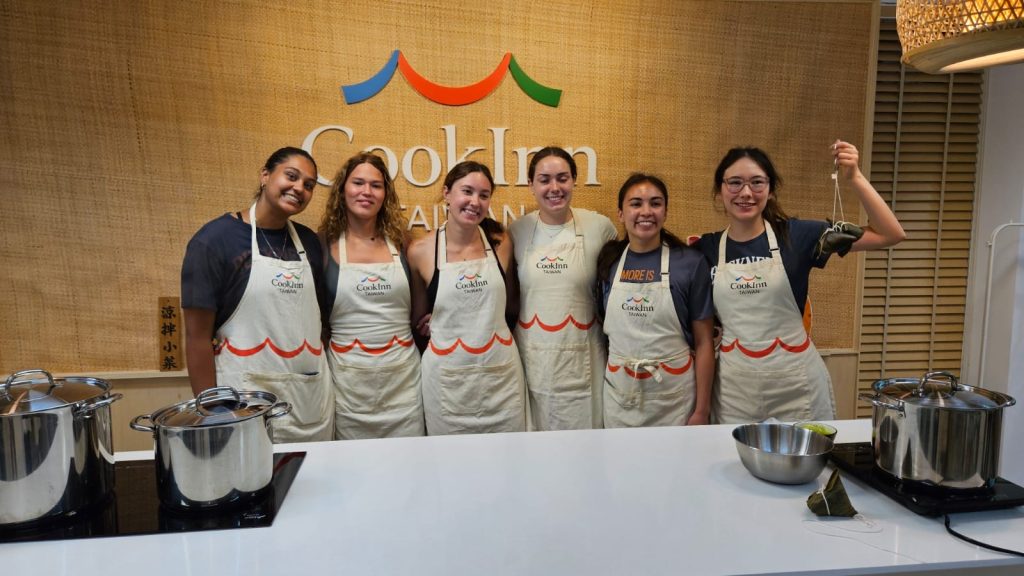
Today our only official engagement was a cooking class! In honor of the Dragon Boat Festival, we made zongzi. I mentioned zongzi in my post from a few days ago, and it’s so fortuitous that we ended up making some today since I hadn’t gotten to try it!! Turns out it is a lot more labor intensive than I had thought; I’m not the greatest cook, but luckily we were working in teams of five and my teammates were all very skilled. I also got a lot of help from our teacher, and when she complimented my zongzi at the end of the process I said that it was really all her haha. The first step is to prepare the filling. We cooked some dried ingredients such as dried shrimp, dried radish, and dried onion. We also braised pork with squid strips, and the egg yolks and boiled peanuts were already prepared. The hardest part was putting it all together: you had to fold two banana leaves to make a cone, stuff it with rice and the other ingredients, then fold it into a pyramid with four sharp corners so you can hang them from string and boil them. It turns out that folding banana leaves is my Achilles heel, and I had to turn to help for anything involving those.
We also made boba tea while waiting for the zonzi to finish boiling. Turns out that the “bubble” in bubble tea does not just refer to the boba, but also to the foamy bubbles that form on top of milk tea when it is prepared in a shaker. The word for boba has… less savory origins that you can Google. Just don’t go calling people boba. The boba in Taiwan originated when sago was brought over from other parts of Southeast Asia, but the main ingredient had to be changed to sweet potato starch since that is a more prevalent ingredient on the island. Apparently people will sometimes call themselves the “children of sweet potato” because of how much sweet potato there is and also how Taiwan is kind of shaped like one.

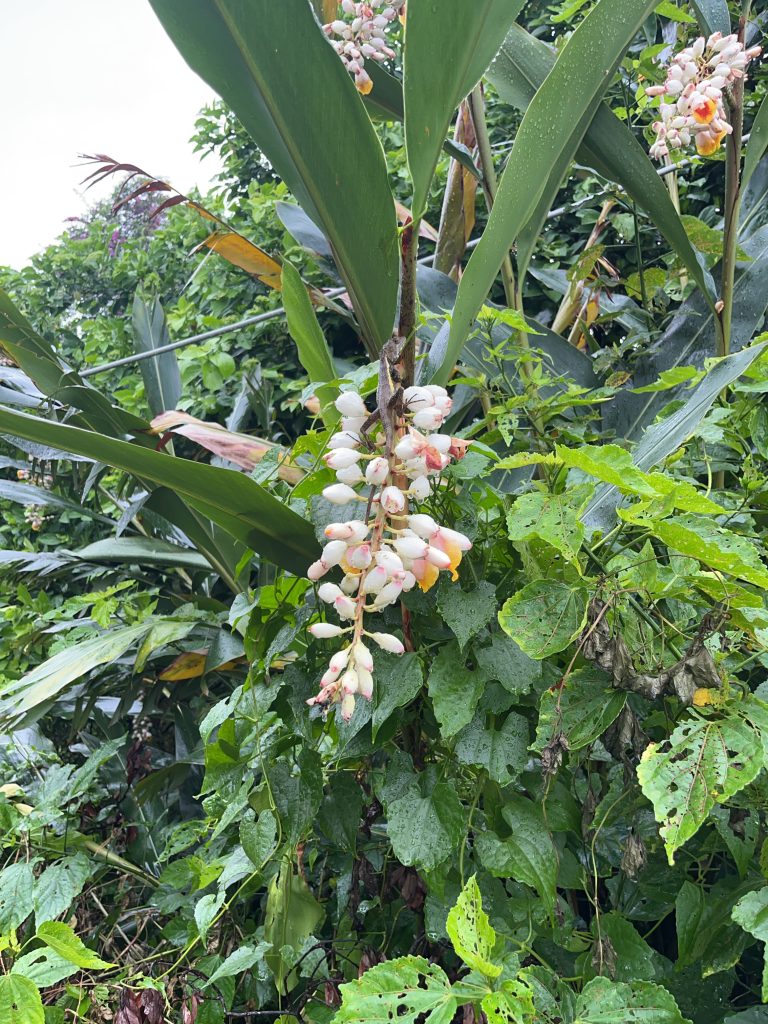
Since we had a lot of free time to ourselves, a handful of us decided to go on a fun hiking trip on the Jiantanshan trail in the north. We thought we were hiking the Elephant Mountain Trail, but turns out that is much closer to Taipei 101 than where we were. The trail was pretty much all staircases, another one of my weak points in life. The highest point on the trail is apparently about 200 meters above sea level. There were many temples and other gathering places along the trail, but we did not run into a whole lot of people. To be fair, it was pretty muggy and wet so perhaps they were not the best conditions for visitors. It felt like crawling through the jungle, and I found and identified lots of local species of flora and fauna. Lot’s of huge snails. The views were great up at the top too, it was definitely all worth it. On the way down, we saw and heard more signs of life. Some people were working out and lifting weights, and I heard a man singing karaoke from somewhere I couldn’t see.




After that, some of us decided to keep the ball rolling and went back to Beitou to see some of the attractions that were closed on the Monday we went last. We trekked up to the Thermal Valley first, which has a story surrounding it featuring a witch with healing abilities. The lake was quite smelly, as it turns out that the Beitou hot springs are sulphorous. This makes the water an iridescent green color but also makes the steam thicker and more acrid. There were some cool trees and a waterfall by the wooden walkway, but we quickly made our way back to the central park to see the Beitou Hot Spring Museum.


This museum has free admission and was a really cool example of Japanese architecture in Beitou. We were asked to remove our shoes upon entering and put on slippers before walking around on the smooth hardwood floors. The first room you see is a large space lined with tatami mats with a stage up front. This was a very comfortable spot to sit and it was really tempting to lay down for a while, which explained the signs prohibiting you from doing so. The basement level contained the bathouse in which only the large pool was still filled with water. I took the picture in the center below to make it look like I had gotten into the bath, but in reality the public has more restricted access to the hot springs than it had in the past and the one public bathhouse nearby was closed for renovations. I’m so glad I got to come back here and see even more of Beitou’s history.


